
🧠 Neurogram
Senior Frontend Engineer - React.js 📅 Nov 2023 - Nov 2024

🌲 Project Treemap

🧱 Tech Stack
- Backend and Cloud: Firebase
- Build Configuration: Install, NPM, Vite, Vite Plugin JavaScript Obfuscator, Vite Plugin SVGR, Vite TSConfig Paths
- Charts and Visualization: Plotly JS, Plotly JS Basic Dist, Plotly JS Dist, React Minimal Pie Chart, React Plotly JS, Victory Native
- Component Library and UI: Bootstrap, Framer Motion, React Draggable, React Zoom Pan Pinch, React Device Detect, React Helmet Async, React Intersection Observer
- Crypto: Crypto ES, JSEncrypt
- Data Fetching and Networking: Axios, Axios Retry, React Use WebSocket, Retry
- Date and Time: Day JS, Moment
- Documents and PDFs: React PDF Renderer, Canvas2Image, HTML2Canvas, JSPDF, PDFJS Dist, Quill To PDF, React PDF
- Encryption and Security: Crypto ES, JSEncrypt
- Forms and Validation: Hookform Resolvers, React Hook Form, Yup, Yup Locales
- Internationalization: Brazilian Utils, Get User Locale, I18Next, React I18Next, Yup Locales
- JavaScript Framework: React, React DOM
- Media and Players: React Player, Video React
- Mocking and Testing: Mirage JS, MSW, Jest, ESLint, ESLint Plugin React Hooks, ESLint Plugin React Refresh, TypeScript ESLint Plugin, TypeScript ESLint Parser
- Routing: React Router DOM
- State Management: React Query
- Storage: LocalForage, LocalForage Session Storage Wrapper
- Styling and Normalization: Modern Normalize
- Text and Editors: Suneditor, Suneditor React
- Utilities: Buffer, Filt, Get User Locale, Lodash, Match Sorter, Randomatic, ShortID, Sort By, Stream Browserify, UUID
- Visualization Enhancements: React Zoom Pan Pinch, React Draggable, Plotly JS, React Plotly JS
- Web Platform: React DOM, React Native Web
🌟 STAR Cases
STAR Case - Fragmented codebase
Situation
The previous codebase combined Rails, React, Tailwind, GraphQL, and Docker across multiple repositories with duplicated components and scattered configs. This fragmentation caused long onboarding times, inconsistent standards, and clear signs of vendor lock-in.
Task
Considering the in-house team’s low seniority and the complexity of the project, I set out to reshape the project’s stack, replacing dependency hell with an architecture that was simple, maintainable, and sustainable, pursuing the following objectives:
- Standardize tooling into a single, reliable workflow.
- Accelerate onboarding so developers could focus on building instead of setup.
- Align stack with team skills rather than forcing over-engineered solutions.
- Prevent future rewrites by choosing technologies compatible with the existing backend.
Actions
My first step was to assess what could be salvaged from the frontend. After several attempts, I confirmed that refactoring would be slower than starting fresh. Between Next.js and Vite, the latter was chosen for its faster builds, simpler configuration, and better alignment with the backend stack based on Firebase and Google Cloud Platform.
Instead of leaving developers to wrestle with separate Babel, PostCSS, Tailwind, and Docker setups, I collapsed dependencies into one consistent Vite configuration. This dramatically improved setup time and enabled features like obfuscation and vendor chunking by default.
Below is the build configuration file I introduced:
import react from "@vitejs/plugin-react";
import tsconfigPaths from "vite-tsconfig-paths";
import obfuscatorPlugin from "vite-plugin-javascript-obfuscator";

type buildConfigOptions = {
  manualChunks?: boolean;
  vendors?: string[];
};

export const buildConfig =
  ({ vendors, manualChunks }: buildConfigOptions = {}) =>
  ({ mode, command }) => {
    const isProdBuild = ...;
    const noMinify = ...;
    const minify = ...;

    const vendorPath = [
      "jsencrypt",
      "i18n",
      "yup",
      "lodash",
      "dayjs",
      ...
      "lib-framework/src/fonts",
      "lib-framework/src/icons",
      "lib-framework/src/assets",
      "lib-framework/src/hooks",
      "lib-framework/src/tokens",
      "lib-framework/src/components",
      ...(vendors || []),
    ];

    const config = {
      define: {
        "process.env": {},
      },
      plugins: [
        react(),
        tsconfigPaths(),
        obfuscatorPlugin({
          apply: () => isProdBuild,
          ...
        }),
      ],
      build: {
        minify,
        rollupOptions: {
          treeshake: true,
          output: {
            manualChunks(id: any) {
              if (!manualChunks) {
                ...
              }

              for (const vendor of vendorPath) {
                ...;
              }

              return ...;
            },
          },
        },
      },
      ...

    return config;
  };
Results
- Build security improved: JavaScript obfuscation protected intellectual property and reduced reverse-engineering risks.
- Bundle performance optimized: vendor chunking and tree-shaking in the Vite configuration reduced payload size and improved runtime efficiency.
- Maintenance costs lowered: collapsing scattered configs into a single pipeline simplified upkeep and reduced time wasted troubleshooting environment inconsistencies.
- New projects bootstrapped quickly: standardized Vite setup enabled starting fresh projects in minutes with all necessary configurations ready to use.
- Onboarding accelerated: environment setup time dropped from 5 days to 5 minutes, making it straightforward for developers of any seniority level to start coding immediately.
- Team focus regained: developers shifted attention back to delivering features instead of resolving fragmented build and config issues.
STAR Case - Unreliable Deployments
Situation
The deployment pipeline was entirely controlled by the consultancy, including the production and staging environments. Deployments were triggered automatically with every change, but the maturity of the software and the team was not ready for such automation. As a result, bugs were introduced directly into production, breaking the user experience and creating unnecessary troubleshooting overhead for the team.
Task
Shift the ownership of the pipeline and environments back to the company, simplify the deployment, and give full control to the in-house team. The objective was to design a fast, easy, and manual deployment flow that would only run when a developer explicitly triggered it, reducing accidental breakages in production.
Actions
I redesigned the deployment process using the minimum resources and complexity possible. Since the company was part of the Google for Startups program, the infrastructure of choice was Firebase. To make deployments simple and predictable, I created a GitHub Actions workflow that consolidated all frontend projects one codebase. This ensured the process was manual, quick, and transparent, while eliminating the hidden consultancy-owned pipelines.
Below is the GitHub Action I authored to handle all frontend projects in one place:
name: manual deploy

on:
  workflow_dispatch:
    inputs:
      project-name:
        type: choice
        ...
      build-type:
        type: choice
        ...
env:
  ...

run-name: ${{ inputs.build-type }} TO ${{ inputs.project-name }} AT ${{ github.event.repository.pushed_at }} WITH ${{ github.sha }}
jobs:
  deploy_firebase:
    runs-on: ubuntu-latest

    defaults:
      run:
        working-directory: ${{ github.workspace }}/proj-${{inputs.project-name}}/

    steps:
      ...
      - name: Deploy
        run: |
          curl -sL https://firebase.tools | bash
          firebase deploy --only hosting:target-${{inputs.project-name}} --token ... --project=project-${{inputs.project-name}}-DEV --config="../lib-framework/firebase.json"
Results
- Auditable and predictable deployments: GitHub Actions provided structured logs and version traceability, ensuring every release could be tracked and verified.
- Full control of environments: staging and production ownership returned to the in-house team, preventing external bottlenecks and restoring confidence in releases.
- Independence from external vendors: embedding the deployment pipeline internally removed reliance on opaque consultancy infrastructure and secured long-term ownership.
- Production incidents virtually eliminated: replacing consultancy-controlled auto-deploys with manual GitHub Actions workflows reduced the risk of pushing unstable code directly into production.
- Simplified release governance: a single reusable workflow handled all frontend projects, reducing coordination overhead and increasing team-wide transparency.
- Streamlined deployment process: releases became a two-click manual action, intentionally designed to be easy and reliable for any seniority level on the team.
STAR Case - Code duplication
Situation
Multiple projects implemented the same logic for API calls, encryption, i18n, and UI components. This led to frequent code duplication, inconsistencies between projects, and bugs caused by drift in how core features were handled.
Task
Eliminate duplicated logic by creating a single framework that standardized core features and could be reused across all projects. The goal was to ensure consistency, reduce maintenance overhead, and accelerate new project setups.
Actions
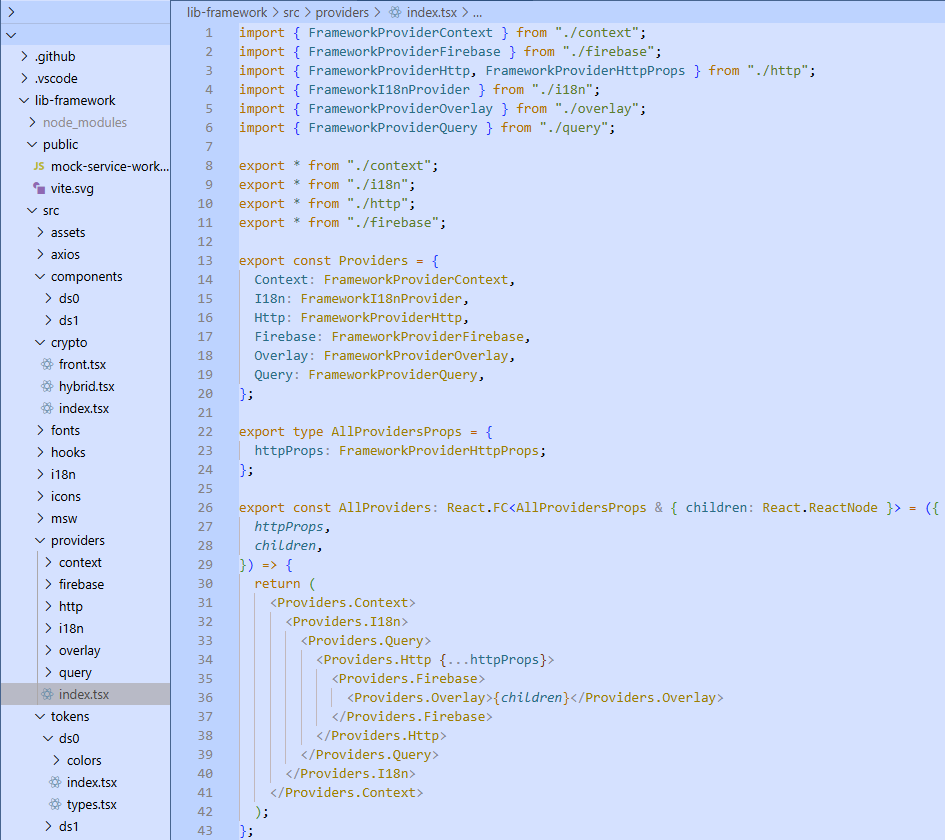
I authored a centralized internal library-framework that included:
- A custom axios layer with interceptors and typed adapters.
- A unified crypto module using a hybrid combination of RSA and AES.
- Mock Service Worker patterns and mock data for consistent testing and development.
- Preconfigured project templates and setup files to enable fast project creation.
- Providers for Firebase, context, i18n, overlay, and query handling.
- Reusable UI components and design tokens.
Results
- Bug rates reduced: redundant and inconsistent duplicate logic was eliminated, reducing maintenance issues.
- Core features by default: i18n, crypto, HTTP, and mocks were included by default in every project.
- New projects scaffolded in minutes: a complete baseline setup was instantly available for new development.
- Single source of truth: centralized frontend architecture improved maintainability and increased team productivity.